Species
Minke whale in the north Minch, from land
The large whale a shore watcher on the Minch is most likely to meet, and the one most often missed, because it does not announce itself with a blow.
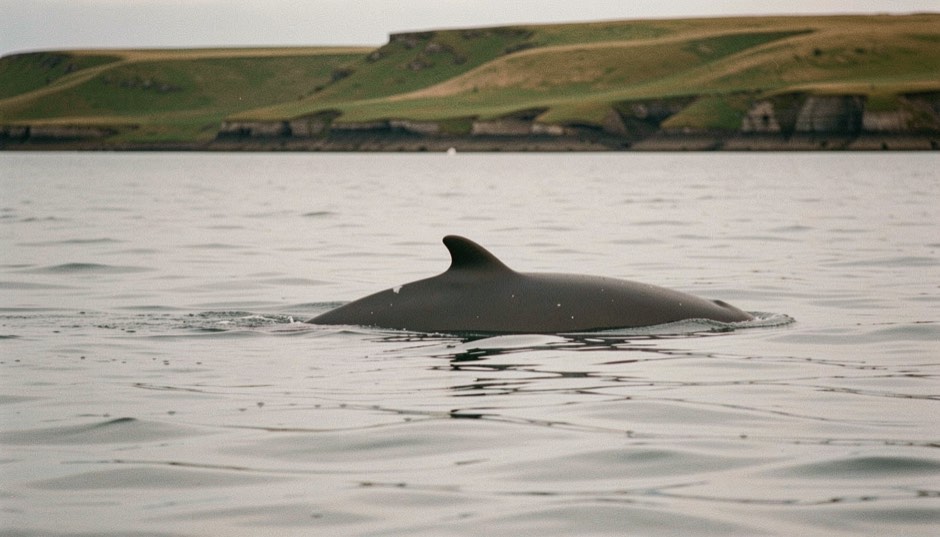
The minke whale is the whale most people on this coast actually see, and the reason it is missed so often is that it does not behave the way a whale is expected to behave. There is no tall spout to catch the eye. The Hebridean Whale and Dolphin Trust puts it plainly in its species profile: a minke whale’s blow is not often visible at sea. What you get instead is a dark back that rolls up, holds for a second or two, and is gone.
What are you actually looking for?
Size first. The Trust gives 7 to 10 metres for a fully grown animal, females usually slightly longer than males, which makes this the smallest baleen whale in UK waters and still far larger than anything else you will see rolling at the surface here. The body is slender and the head narrow and pointed.
Then the fin. It sits about two thirds of the way down the back, it is sickle shaped, and, crucially for a watcher at distance, the Trust notes that it is visible at the same time as the blowhole when the animal surfaces. That single detail separates a minke from almost everything else on this coast. A dolphin shows a fin. A minke shows a long stretch of back with a fin at the far end of it, all in one movement.
The surfacing rhythm, and why it matters
A minke is not a random event. The Trust describes the typical dive sequence as five to eight blows at intervals of less than a minute, followed by a dive that usually lasts three to eight minutes. For a watcher this is the most useful fact in the entry, because it turns one sighting into a plan.
Working a surfacing sequence
First surfacing: note the direction of travel and the time. Expect four to seven more surfacings in the next few minutes, roughly in line, then a gap of three to eight minutes.
During the gap, do not scan the whole bay. Hold the projected line of travel and wait. Most animals lost after a first sighting are lost by looking everywhere at once.
When are they here?
The Trust’s factfile gives April to October for minke whales in the Hebrides, and its distribution note says they are frequently seen in coastal and inshore waters through that window. The sharper detail comes from Whale and Dolphin Conservation, whose Shorewatch analysis, published on 1 February 2026, reports a clear June to July peak in minke sightings and names Tiumpan Head in the Outer Hebrides as one of the sites where that peak stands out.
That gives a shore watcher a straight answer to the only planning question that matters. If a trip is being built around one species, the two months are June and July, and the north east coast of Lewis is where the standardised watches record them most. Outside that window the animal is still in the Trust’s range, but the record thins, and a watcher should plan for a long blank rather than a run.
What gives them away when the sea is empty
Minkes on this coast feed, and feeding leaves a signature above the water before it leaves one on it. The Trust records that minke whales in the Hebrides are commonly seen feeding in association with seabirds, in particular kittiwakes, Manx shearwaters and young gulls, and describes lunge feeding, in which the whale comes at a shoal from below and erupts at the surface with its throat grooves extended.
In practice this means a working flock of seabirds is worth more of your attention than an empty horizon. The Hebridean Whale Trail gives the same advice for the same reason: seabirds often feed on the same food as whales and dolphins. A distant swell breaking over a rock produces a false back that does not move. A minke moves, and it moves in one direction.
What can be confused with it
Very little, once the back has been seen properly. The problems come at the edges of visibility. A basking shark, which the Hebridean Whale Trail lists at 6.5 to 10 metres, can present a large triangular fin at the surface in late summer, but the Trail gives the test: sharks swim with a side to side motion, while whales and dolphins move up and down. A harbour porpoise at range is the other trap, and the answer is the length of back on show: a porpoise is a small roll, a minke is a long one.
Honest limits
None of the above is a promise. The Hebridean Whale Trail’s Spotter’s Guide is direct about it: you are by no means guaranteed to see a whale or a dolphin at any site, because they are wild animals and can be frustratingly elusive. A blank watch recorded properly is still a useful record.
Protection, and the record a watcher can add
Minke whale is one of the qualifying features of the Sea of the Hebrides Marine Protected Area, designated by the Scottish Government in December 2020 in a group of four sites which, as the Hebridean Whale and Dolphin Trust reported at the time, included the first Marine Protected Areas for minke whales in the UK. Separately, under regulation 39(2) of the Conservation (Natural Habitats, &c.) Regulations 1994 it is an offence to deliberately or recklessly disturb any dolphin, porpoise or whale.
A watcher adds to that record with a camera. Minke dorsal fins accumulate marks and scars permanent enough to identify an animal, and the Trust states on its species profile that over 250 individuals have been identified in the Hebrides by photo identification. A photograph taken from a headland, however poor, is therefore worth keeping and sending in: a fin with a notch in it is a record, not just a picture.
Sources
- Hebridean Whale and Dolphin Trust, Minke Whale species profile, hwdt.org, consulted 5 September 2026.
- Whale and Dolphin Conservation, Shorewatch analysis by Alice Walters, published 1 February 2026.
- Hebridean Whale Trail, Spotter’s Guide, whaletrail.org, consulted 5 September 2026.
- Hebridean Whale and Dolphin Trust news, Marine Protected Areas designated, 3 December 2020.