Species
Harbour porpoise: a small roll, close in
Recorded in every month of the year in the Hebrides, present in numbers among the highest in Europe, and invisible above sea state 2. The porpoise is a lesson in conditions.
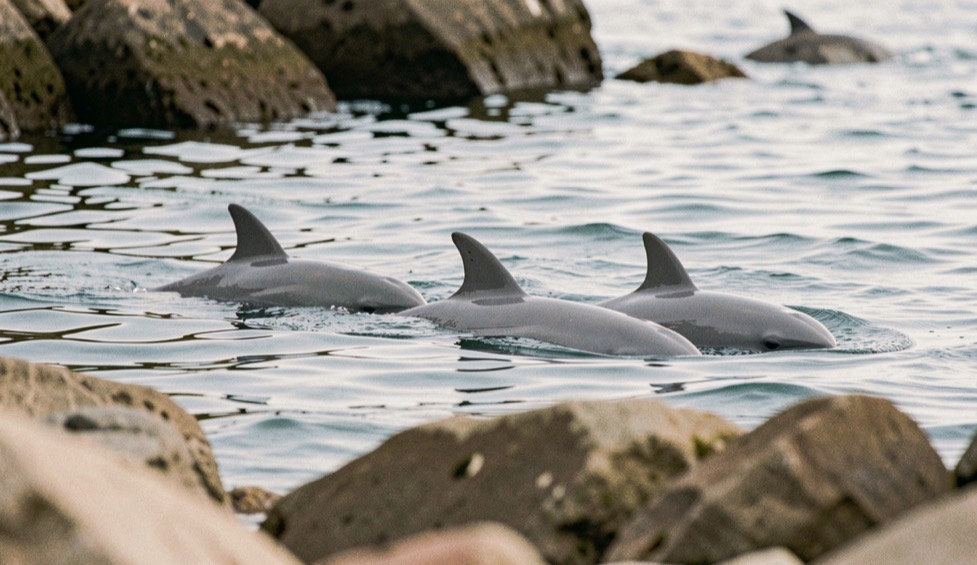
If a shore watch on the Minch produces one cetacean, it will most often be this one, and the reason is not that porpoises are showy. It is that they are everywhere and they are close. The Hebridean Whale and Dolphin Trust records harbour porpoise in every month of the year in the Hebrides, describes them as widespread throughout coastal regions, and states that the number in Hebridean waters is among the highest in Europe.
What are you actually looking for?
A small dark back and a triangular fin, close in. The Trust gives 1.4 to 1.9 metres and around 68 kilograms, which makes this the smallest cetacean of the Hebrides. The head is blunt, the body stocky, and the dorsal fin is triangular and set in the middle of the back, where it becomes visible as the animal surfaces. The back and pectoral fins are dark grey, the sides lighter, the throat and underside white, though from a headland the only colour you will register is dark. The Gaelic name recorded by the Trust is peileag.
There is no blow to look for. The Trust notes that the blow is not normally visible but that a puffing sound is often heard, which is where the old nickname puffing pig comes from.
Behaviour, and what it rules out
Porpoises are seen briefly, when they surface to breathe, commonly in groups of two to five. The Trust describes them as elusive, rarely approaching vessels and not known for aerial activity. Two practical conclusions follow. First, a leaping animal on the Minch is not a porpoise; it is a dolphin. Second, a boat in the frame reduces rather than improves your chance, which is exactly why the shore is a good place to watch this species.
Feeding gives the best chance of a run of sightings. The Trust records that when feeding they commonly surface about four times every 10 to 20 seconds before diving for up to six minutes. Those short repeated rolls in one small patch of water are the signature to look for.
Why are they always so close to shore?
Because their food is. The Hebridean Whale and Dolphin Trust records a diet of over 20 different species of fish, squid, octopus and shellfish, with herring, sprat and sandeel making up a large part of it in Hebridean waters. Those are shoaling fish of shallow, productive coastal water, which is precisely why this species is the one a shore watcher meets rather than one that stays out beyond the horizon. The teeth are small and spade like, for catching prey rather than chewing it; the animals hunt with echolocation clicks.
Sheltered water is where that shows. The Hebridean Whale Trail describes Loch Broom at Ullapool as a calm sea loch and a perfect home for harbour porpoise, and lists harbour porpoise first among the species to look for there. The same list appears for Kilt Rock on Skye and for Gairloch.
Why this species has a protected area of its own
On 25 September 2016 the Scottish Government designated the Inner Hebrides and the Minches Special Area of Conservation, Scotland’s first Special Area of Conservation for harbour porpoise and, on the Government’s own description, the largest in Europe for the species. The published figures are precise: the site covers 13,801.99 square kilometres and supports over 5,000 individuals. The Joint Nature Conservation Committee lists it under site code UK0030393 with harbour porpoise as the Annex II species that is the primary reason for selection.
The Scottish Government stated at designation that the site fulfils its legal obligation to protect porpoises over and above European Protected Species status. That status is the second layer: regulation 39(2) of the Conservation (Natural Habitats, &c.) Regulations 1994 makes it an offence to deliberately or recklessly disturb any dolphin, porpoise or whale.
What threatens them
The Trust is specific. Because of their feeding habits they are at high risk of entanglement in fishing gear, and it is believed that several thousand may be entangled and drowned each year in UK waters, primarily in gill nets. Their distribution overlaps the most heavily used parts of the coast, so they are exposed to shipping, coastal development and underwater noise, including from acoustic deterrent devices used by some fish farms. Killer whales are named as their main natural predator in the Hebrides.
Recording a porpoise properly
The Sea Watch Foundation form asks for minimum and maximum group size, not a single number: the minimum is the greatest number seen at the surface at once, the maximum an estimate over a five to ten second period. For an animal that surfaces this briefly, that distinction is the whole record.
Turning a watch into a record
Because this species is common, a single porpoise sighting adds little on its own. What adds something is effort recorded consistently from the same place. The Sea Watch Foundation is blunt about why: if we do not know how many hours were spent watching, we do not know whether the absence of animals at a particular time of year simply means that no watching was conducted. Recording no animals, with the conditions, is a contribution.
Detection window
A rolling back this small is effectively invisible in broken water. On the Sea Watch Foundation land based scale, sea state 3 is large wavelets with crests beginning to break and a few whitecaps: that is the point at which porpoise detection collapses.
Plan porpoise watching for sea state 0 to 2, which is mirror calm to small wavelets with glassy crests and no whitecaps.
Sources
The facts on this page were read back against the pages below on 5 September 2026.
- Hebridean Whale and Dolphin Trust, Harbour Porpoise species profile, consulted 5 September 2026.
- Scottish Government, Protection for harbour porpoise, published 25 September 2016.
- Joint Nature Conservation Committee, Inner Hebrides and the Minches SAC, site UK0030393.
- Sea Watch Foundation, How to complete SWF Recording Forms, form SWF/RF0.