Seasons and sea state
Sea state, and what each step hides
One number, from zero to seven, explains more about a blank afternoon than any other single thing a shore watcher can write down.
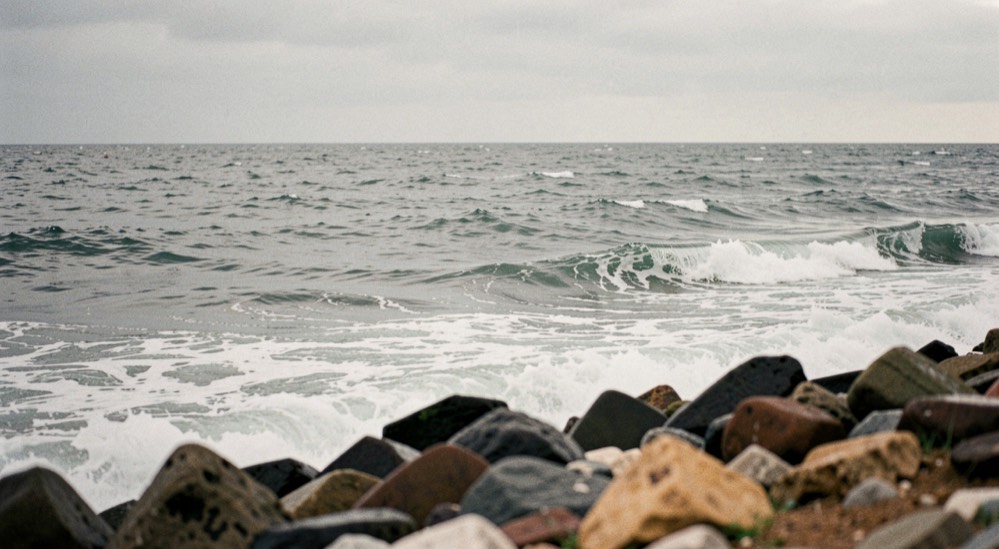
Ask a shore watcher why they saw nothing and the answer is usually about the animals. It is almost always about the surface. The Sea Watch Foundation records sea state on its land based effort and sightings form as a number from 0 to 7, with a written definition for each step. This entry takes those definitions and asks a single question of each one: what has just disappeared?
The scale, as published
| Value | Definition | What it costs a shore watch |
|---|---|---|
| 0 | Mirror calm | Nothing. Every roll and every slick is readable. |
| 1 | Slight ripples, no foam crests | Nothing meaningful. Still the best working condition. |
| 2 | Small wavelets, glassy crests, but no whitecaps | Distant small animals get harder. Porpoise range shortens. |
| 3 | Large wavelets, crests begin to break, few whitecaps | Porpoise detection largely gone. False positives begin. |
| 4 | Longer waves, many whitecaps | Small dolphins unreliable. Only fins and blows survive. |
| 5 | Moderate waves of longer form, some spray | Large whales only, and only when they blow or breach. |
| 6 | Large waves, whitecaps everywhere, frequent spray | Effectively no cetacean watching. |
| 7 | Sea heaps up, white foam blows in streaks | Recording effort only, and safety first. |
Which step costs the most?
The one from 2 to 3. Everything up to sea state 2 is glassy crested wavelets with no whitecaps. At 3 the crests begin to break and the first whitecaps appear, and the sea acquires thousands of small white marks that look exactly like the splash of a small animal surfacing.
A harbour porpoise is 1.4 to 1.9 metres long, rolls forward for a fraction of a second, and produces no visible blow. Put that animal in a sea with whitecaps on it and it is not scarce; it is invisible.
Two things happen at once there. Real animals stop being visible, and false ones start appearing. A watcher who does not know the difference will report more, not less, in worsening conditions, which is precisely why the recording form asks for the number.
Why this is not pedantry
Because the whole value of a shore record depends on it. The Sea Watch Foundation explains why it wants weather data at all: poor weather affects an observer’s ability to see and identify cetacean species, and recording the weather helps it assess sighting efficiency.
What to write down before you start
Sea state, 0 to 7. Swell height: light under one metre, moderate one to two metres, heavy over two metres. Visibility: under one kilometre, one to five, six to ten, over ten. Glare and lighting: 0 no glare and excellent lighting, 1 mild glare and good lighting, 2 moderate glare and moderate lighting, 3 strong glare and poor lighting.
Four numbers, thirty seconds, and the rest of the watch means something.
How do you judge it without instruments?
By the water, not by the wind, and the definitions are written to make that possible. Foam crests are the first threshold: below them you are at 0 or 1. Glassy unbroken crests put you at 2. The first scattered whitecaps put you at 3, many whitecaps at 4, and the appearance of spray blowing off the tops at 5.
The distinction people get wrong is between swell and sea state. A long, smooth two metre swell with no whitecaps on it is a heavy swell at a low sea state, and it hides animals in its troughs while leaving the surface readable on the crests. That is why the form asks for both, separately.
Matching a site to a number
This is where the scale becomes a planning tool rather than a form field. The exposed Atlantic sites in this journal, the Butt of Lewis above all, can be at 5 while a sea loch twenty miles away is at 1. On a bad forecast the question is not whether to go out, but which of the five watch points is still readable.
The sheltered end of that list is Rhue and Loch Broom, which the Hebridean Whale Trail describes as a calm sea loch. The exposed end is the Butt of Lewis, where the Trail says the restless Atlantic rolls against the cliffs. Both are good sites; they are good in different weather.
What height cannot buy
A sighting at sea state 1 and a sighting at sea state 4 are not the same observation, and a blank at sea state 5 says nothing at all about the sea. The number, written down honestly, is what decides how much a watch is worth, and height buys perhaps one step of it, not three. That is the honest limit of the whole exercise.
Height helps, up to a point
A clifftop lets you look down into troughs rather than across crests, which buys perhaps one step of sea state compared with a beach. It does not buy three. At sea state 5 a clifftop is a fine place to watch weather.
Sources
The facts on this page were read back against the pages below on 5 September 2026.
- Sea Watch Foundation, How to complete SWF Recording Forms, form SWF/RF0, data definitions for the land based effort and sightings form.
- Hebridean Whale and Dolphin Trust, Harbour porpoise species profile, consulted 5 September 2026.
- Hebridean Whale Trail, Ullapool and Butt of Lewis site pages, consulted 5 September 2026.