Seasons and sea state
Swell, visibility and glare on a shore watch
Sea state gets the attention. Swell hides animals in troughs, haze eats the far half of the sector, and glare removes the method altogether.
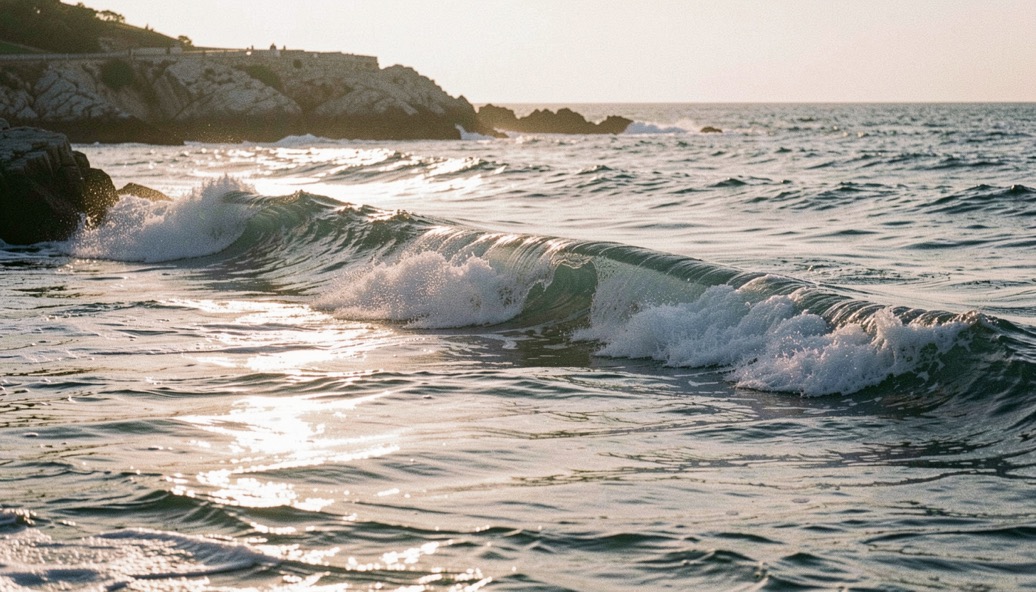
The Sea Watch Foundation land based recording form asks for four environmental values, not one. Sea state is the famous one and has an entry of its own in this register. The other three are swell height, visibility and glare, and between them they explain most of the afternoons that a sea state number alone cannot. Swell hides animals in troughs. Haze eats the far half of the sector. Glare removes the method altogether. This entry takes the three in turn, then together, and keeps to what the form itself defines.
Swell height
The published categories are simple: light is under one metre, moderate is one to two metres, heavy is over two metres. What makes swell different from sea state is that it can be large while the surface is smooth, the condition that most often fools a watcher into expecting an easy afternoon.
A two metre swell puts a wall of water between you and anything in the next trough. From a low shore such as Clachtoll, a moderate swell alone can hide a harbour porpoise completely even at sea state 1. From a clifftop such as Kilt Rock you look down into the troughs rather than across them, and the same swell costs far less.
Swell against site, in one line
Light swell: every site in this journal works.
Moderate swell: prefer height. Kilt Rock and the clifftop positions hold up; a low shore starts losing small animals.
Heavy swell: sheltered water only, which on this coast means Loch Broom.
What does a blank watch actually mean?
It means no animals inside the distance the visibility band allows you to claim, which is why the band belongs on the form. The form records four bands: under one kilometre, one to five kilometres, six to ten kilometres, and over ten. Those bands are not about comfort. They are the outer edge of your search area, and they change what a blank watch means.
On the Minch, a watcher at Tiumpan Head can have the mainland mountains sharp on the horizon or nothing beyond two kilometres, on days that look similar from a car park. Recording the band converts a blank into information: no animals within five kilometres is a fact, no animals seen is not.
Fog and haze behave differently. Fog announces itself. Summer haze does not, and it is the more common cause of a wasted long range watch on this coast.
How much of the glare is under your control?
More of it than any other condition, because glare depends on where you stand and when you go. The scale runs 0 for no glare and excellent lighting, 1 for mild glare and good lighting, 2 for moderate glare and moderate lighting, and 3 for strong glare and poor lighting.
Most of the watch points in this journal look east or north east across the Minch. Tiumpan Head faces the mainland across the Minch, the Trotternish cliffs at Kilt Rock look across the Sound of Raasay, and Clachtoll and Rhue face west and north west from the mainland side. On the Lewis sites, that means morning sun into the sector and evening sun behind you. On the mainland sites it is the reverse.
A watcher who plans nothing else can still double the value of a trip by turning up at the hour when the sun is behind their shoulder.
How the four values work together
They compound rather than average. A moderate swell at sea state 3 with glare 2 is not three small problems; it is a sector in which nothing under three metres long will be seen at all. Conversely, sea state 1 with light swell, visibility over ten kilometres and glare 0 is the combination in which a harbour porpoise at eight hundred metres is a realistic record.
Those good combinations are not rare on this coast. They are simply not distributed evenly across the day, and they favour the early morning in summer and the middle of the day in winter. A watcher who wants that combination plans the hour, not just the day.
Beyond the four environmental values
The four environmental values describe the conditions of a watch, not what came of it. Everything else the page asks for is about the animal and the watching, and the fields are few. What follows is the list as the form gives it.
The rest of the form
The same page also asks for boat activity by type, bearing to the animal in degrees, estimated distance from the nearest coast, the direction the animal is heading, and a behaviour code such as surfacing, feeding, logging, milling, leaping or spy hopping.
None of it requires equipment. All of it turns a memory into a record, and a record is the only part of a watch that outlasts the afternoon.
What this does not cover
Tide. The Sea Watch Foundation land based form does not ask for a tidal state, and this journal will not invent a rule about tide races that its sources do not support. What the published record does say is narrower and worth keeping: the Hebridean Whale Trail notes that smooth patches or lines on the surface can be where water is bringing food up, and that such places are worth watching. Where those lines come from at a given headland is a local question, and a local watcher will answer it better than a page will. The three values in this entry, alongside sea state, are what the standard form asks about conditions; tide is the part left to local knowledge.
Sources
The facts on this page were read back against the pages below on 5 September 2026.
- Sea Watch Foundation, How to complete SWF Recording Forms, form SWF/RF0, data definitions.
- Hebridean Whale Trail, Spotter’s Guide and site pages, consulted 5 September 2026.