Seasons and sea state
Summer on the Minch: peak, haze and glare
The season when the animals are least of the problem. What costs a summer watcher a sighting is usually the sun, the crowd or the hour of the day.
Summer is when the published peaks land. Whale and Dolphin Conservation’s Shorewatch analysis reports a clear June to July peak in minke whale sightings, a summer peak in bottlenose dolphin sightings, and a late summer rise in Risso’s dolphin records. The Hebridean Whale and Dolphin Trust’s window for common dolphins runs from May, and the Hebridean Whale Trail’s Spotter’s Guide lists both minke whale and basking shark as summer coastal sightings.
All of which makes summer the obvious season, and makes the failures of a summer watch worth understanding, because they are not failures of the animals.
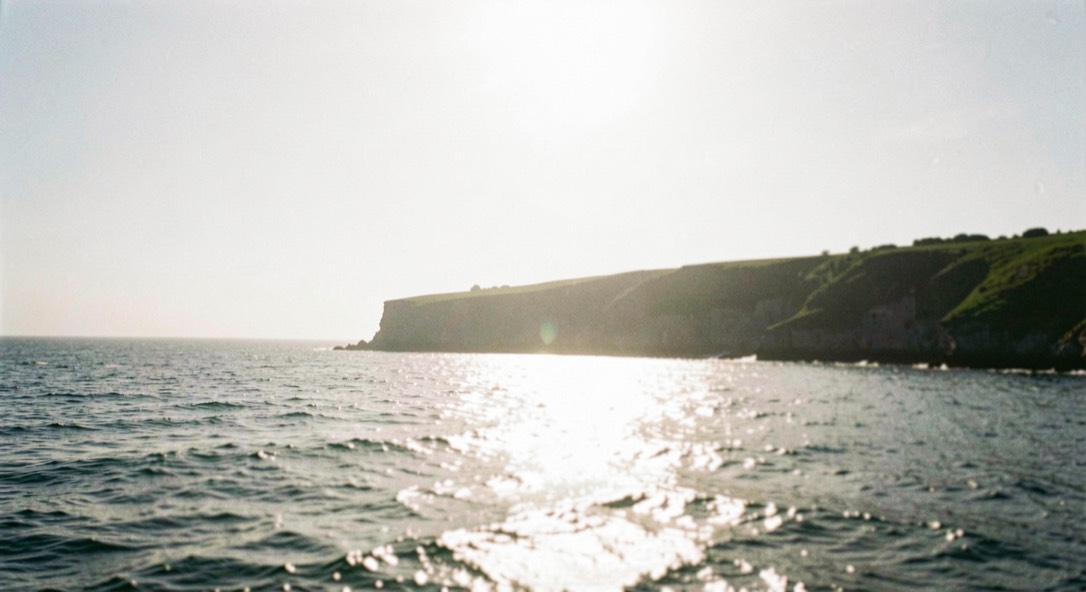
Glare is the main enemy
The Sea Watch Foundation asks land based observers to record lighting on a four point scale: 0 for no glare and excellent lighting, 1 for mild glare and good lighting, 2 for moderate glare and moderate lighting, and 3 for strong glare and poor lighting. In June, on an east facing headland such as Tiumpan Head or Kilt Rock, a mid morning watch can sit at 2 or 3 while the same headland at four in the afternoon sits at 0 or 1.
That is a larger effect than most people expect. A moderate glare across the sector you are searching does not reduce your chances a little; it removes the dark shapes, the glints and the irregular splashes that the Spotter’s Guide tells you to look for, which is to say it removes the entire method.
Haze and the long horizon
The same recording form asks for visibility in four bands: under one kilometre, one to five, six to ten, and over ten. Summer on this coast produces the widest spread of those values, from a flat calm day with the mainland mountains sharp at forty kilometres to a warm hazy afternoon where the far side of the Minch has simply gone.
Haze matters more in summer than fog does in winter, because it is easy to mistake for a good day. The sun is out, the sea is calm, and nothing beyond three kilometres is resolvable. A watch kept in those conditions is not watching the Minch; it is watching the nearest three kilometres of it, and writing off the rest.
What does the peak actually give you?
A better chance, not a different activity. The Shorewatch June and July minke peak means more animals passing a given headland, not animals that behave differently. The Trust’s description of a minke dive sequence, five to eight blows at intervals under a minute then a dive of three to eight minutes, holds in July exactly as it holds in April.
The same applies to common dolphins. A summer pod of 10 to 30 animals, or occasionally several hundred, is the same animal doing the same thing; there are simply more of them and the food is more abundant, which is the Trust’s own explanation for the May to October window. What the season changes is the food, not the behaviour.
Crowds, and the two sites where they bite
Two of the five watch points in this journal have a real capacity problem in summer. At Tiumpan Head, the Hebridean Whale Trail states that car parking is very limited, that there is no parking in the turning circle in front of the lighthouse, and that a private business in the lighthouse premises requires access at all times. At Kilt Rock, a roadside viewpoint on the main Trotternish route, the parking is ample but the railing is not quiet.
Both problems have the same answer as the glare problem: go early or go late.
Basking sharks
Summer is when the Trail lists basking sharks as a coastal sighting, at 6.5 to 10 metres and in groups of one to 20. Its Gallan Head page gives the test that stops a shark being written down as a whale: sharks swim with a side to side motion, whales and dolphins move up and down.
Feeding, and the birds that mark it
Summer is the season in which the seabird cue works best, because the birds are on the coast in numbers. The Trust records minke whales in the Hebrides commonly feeding in association with kittiwakes, Manx shearwaters and young gulls, and common dolphins in association with diving gannets. The Trail’s advice at Gairloch is the same in plain terms: watch for feeding gannets, because the food that draws them is the food that draws whales and dolphins.
The two sources together give the summer watcher one instruction: watch a patch of water where birds are working, and keep watching it, because the food that drew the birds is the food that draws the whales and dolphins, and a summer watch that follows the birds is working with the season rather than against it.
What do you do with a flat calm July morning?
Use it, and use it early. Sea state 0 to 2 in summer is the combination that produces harbour porpoise records as well as the headline species, and the Sea Watch Foundation scale is worth reading against the water: 0 is mirror calm, 1 slight ripples with no foam crests, 2 small wavelets with glassy crests but no whitecaps. Those three conditions are when the small animals are findable, and they are commonest at dawn.
The summer rule of thumb
East facing sites, which is most of the Minch coast, watch better in the afternoon and evening in summer. West facing sites reverse it: morning is the clean light and evening is the glare.
Record the glare value with the watch either way. A blank watch at glare 3 says nothing about the sea.
Sources
The facts on this page were read back against the pages below on 5 September 2026.
- Whale and Dolphin Conservation, Shorewatch analysis, 1 February 2026.
- Sea Watch Foundation, How to complete SWF Recording Forms, SWF/RF0.
- Hebridean Whale and Dolphin Trust, species profiles, consulted 5 September 2026.
- Hebridean Whale Trail, Spotter’s Guide, Tiumpan Head, Kilt Rock, Gairloch and Gallan Head pages, consulted 5 September 2026.