Species
Sperm whales beyond the Outer Hebrides
A deep water whale that belongs beyond the shelf. Very rare here, unmistakable when it appears, and most often met on this coast as a stranding.
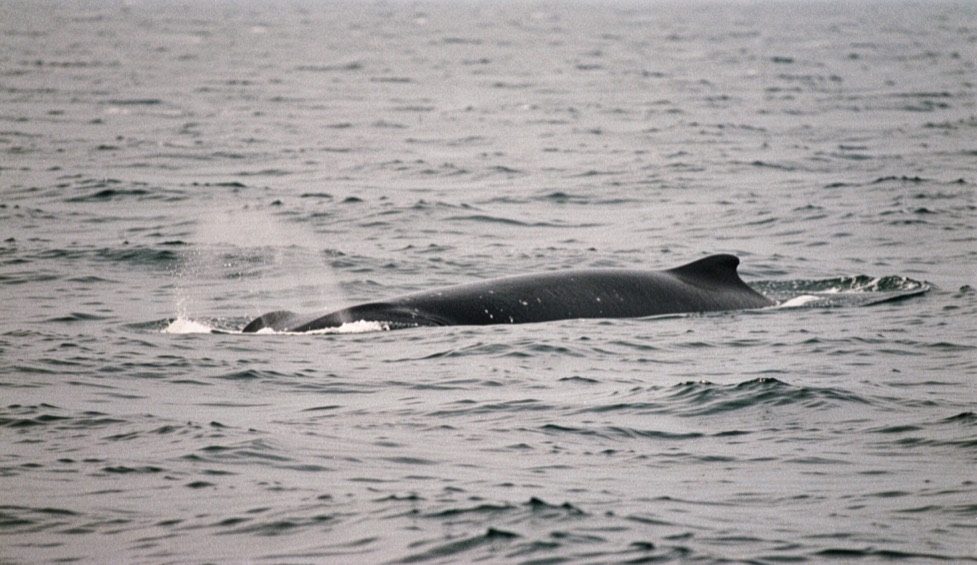
This entry is included for honesty rather than for hope. The Hebridean Whale and Dolphin Trust states that the UK has the highest number of sperm whale sightings in northern Europe, and in the same paragraph that sperm whale sightings are very rare in the Hebrides, with just one or two reports every year, because the animals prefer the deeper waters beyond the Outer Hebrides. A shore watcher on the Minch should expect never to see one.
Why does the blow identify it instantly?
Because it points the wrong way. The Trust describes an S shaped blowhole positioned to the left on top of the head and angled forward, producing a distinct angled bushy blow. Every other whale here blows vertically. A bushy spout leaning forward and to the left, seen once, is a sperm whale and nothing else.
There is no true dorsal fin, only a small triangular hump, behind which a row of bumps runs along the back towards the fluke. The skin is wrinkled and dark grey or brown with white patches underneath and circular scars from squid suckers. The large square head is about one third of the total body length and contains the spermaceti organ, a waxy reservoir involved in sound production and echolocation.
Males can grow to 18 metres, females to about 11. This is the largest of the toothed whales.
What does that dive time mean from land?
It means patience of a different order. A minke gone for three to eight minutes can be waited out. A sperm whale that flukes may be gone for the rest of your afternoon, and may surface again exactly where it went down. If you have a fix on the position and the light holds, staying on that spot is a better plan than searching.
Two behaviours a watcher can use
Logging: the Trust records sperm whales floating motionless at the surface between dives, resting. A large dark shape that does not move for minutes, then blows, is not driftwood.
The fluking dive: a diving sperm whale characteristically arches its back and raises its tail fluke. Dives reach as deep as 2,500 metres and last up to two hours, and animals often return to the same place on the surface.
Social structure, and why they are out there and not here
The Trust describes groups of females with their young male offspring, bachelor herds of juvenile males, and solitary adult males, and states that sightings in the Hebrides are normally of solitary animals. A single very large whale, therefore, rather than a group.
Squid. From stomach contents, scientists know sperm whales feed on up to 40 different species of squid, octopus and cuttlefish, most famously diving to great depth for giant squid up to 12 metres long, and an adult can eat as much as a tonne of squid in a day. Squid at that depth are found over submarine canyons and continental shelf edges, which on this coast means water well west of the Outer Hebrides.
Sound, and the threats that follow it
Sound is the sense this animal lives by. The Trust records that sperm whales use echolocation to navigate and to find food in the dark depths, and that males produce very loud vocalisations known as clangs, believed to be a mating display. The spermaceti organ in the head, which is about a third of the body length, is involved in producing those sounds.
That dependence is also the threat. The species was once hunted commercially for the spermaceti oil used to make candles, and the current threats given by the Trust are accumulation of toxic pollutants such as organochlorines, entanglement in fishing nets, marine litter, and noise disturbance, which interferes with exactly the complex echolocation on which the species relies.
The record, rather than the sighting
The identification set out above is for a sighting that will probably never happen. What the Hebrides produces, on this coast, is a stranding record rather than a sighting: an animal on a shore, alive or dead, and a crowd that should not gather. The Trust places the species beyond the Outer Hebrides, in the deeper water it prefers, and this journal keeps the entry for honesty rather than for hope.
Setting expectations before a watch
One or two reports a year across the whole Hebrides is the published figure. Any page that presents the sperm whale as a realistic target for a shore watch on the Minch is selling something. This journal does not.
If one comes ashore
The Trust notes several records of stranded sperm whales around the British coast, including the Hebrides. This is, statistically, how most people on this coast encounter the species. A stranded animal, live or dead, is a matter for the authorities and not for a crowd: the Hebridean Whale Trail’s guidance to visitors is that if you are worried about an animal you should not approach it, and should contact the relevant agency.
Keep away and report it. A live stranded whale is dangerous to itself and to anyone near it, and a dead one is a scientific record that is degraded by a crowd.
The Gaelic name recorded by the Trust is muc-mhara spùtach. It is the largest of the toothed whales, and on this coast it is far more often a stranding record than a sighting.
Sources
The facts on this page were read back against the pages below on 5 September 2026. The species detail throughout is the Trust profile; the advice on a stranded animal is the Trail guidance.
- Hebridean Whale and Dolphin Trust, Sperm whale species profile, consulted 5 September 2026.
- Hebridean Whale Trail, Responsible Access guidance, consulted 5 September 2026.