Species
Risso’s dolphin: the scarred grey of deep water
The dolphin that gets whiter as it gets older, feeds on squid at night, and has a Marine Protected Area on this coast designated for it.
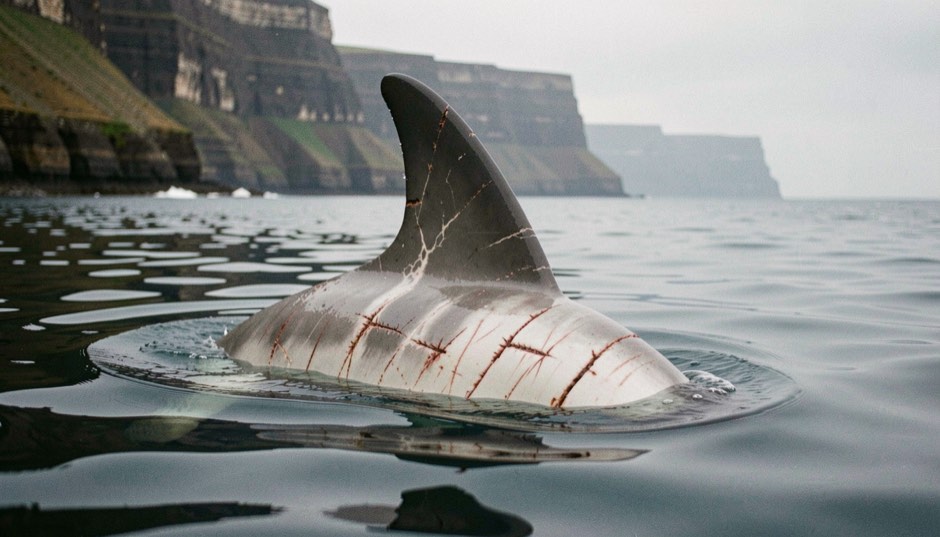
Risso’s dolphin is the species that makes the north Minch distinctive. It is not the commonest animal here and it is not the largest, but the waters off north east Lewis hold it consistently enough that the Scottish Government designated a Marine Protected Area for it, and that is not true of anywhere else a shore watcher can reach on this coast.
Reading one at distance
Three features do the work. The Hebridean Whale and Dolphin Trust describes a robust stocky body, a tall falcate dorsal fin, and a blunt bulbous melon with a unique V shaped crease running from the upper lip to the blowhole. There is no prominent beak.
The fourth feature is the one you will actually notice first. Colour changes with age: calves are born grey and darken as juveniles, then the skin lightens with age, in some cases to silvery grey, while the body becomes increasingly covered in scratches and scars inflicted by other Risso’s dolphins and by prey such as squid. An old animal can read as a pale, almost white shape at a range where nothing else on this coast is pale.
Adults measure between 2.6 and 3.8 metres and can live more than 30 years.
Why is this a species for the shore?
Because an animal that avoids boats is an animal a boat is a poor way to see. The Trust records Hebridean Risso’s dolphins singly or in groups of up to 20 animals, and describes social behaviour that is gregarious and sometimes rough. They can be seen breaching, tail slapping, spy hopping, splashing and sometimes striking one another, but are more commonly seen travelling and surfacing slowly, and rarely approach vessels or bow ride. That last clause is the argument for watching this species from land.
Colour changes so much with age that a single animal cannot be aged confidently from shore, and a group of mixed tones is normal rather than remarkable. What is worth writing down is the number of animals, the direction of travel, and whether any individual was pale enough to read as white. The Gaelic name the Trust records is cana.
Why deep water, and where it comes close
The diet explains the geography. Risso’s feed mainly on squid, with some octopus and cuttlefish, generally at night when their prey migrates towards the surface, and they can dive for up to 30 minutes to depths of 400 to 500 metres. The Trust therefore places them in deeper water in the Hebrides, coming into coastal areas only occasionally.
Their mouths reflect the diet: rarely any teeth in the upper jaw, and only four to fourteen in the lower, enough to seize a soft bodied prey and swallow it whole. The scars from those encounters stay on the skin, which is how a life history becomes visible from a clifftop.
Where the deep comes to the shore, so do they. The Hebridean Whale Trail describes the water just below Tiumpan Head lighthouse as dropping off sharply into depths where some of the more elusive whales and dolphins might appear, and lists Risso’s dolphins first among the species to look for there.
When should you be on the headland?
The Trust’s factfile lists Risso’s dolphin for January to December, so there is no closed season. The Shorewatch analysis published on 1 February 2026 gives the useful refinement: sightings rise in late summer. August and early September on the east coast of Lewis is the combination the standardised watches support.
The hour matters as much as the month. The Trust records that Risso’s dolphins generally feed at night, when their preferred squid migrate towards the surface. An animal that has spent the dark hours working deep water is an animal that may be travelling or resting in the early morning, which is when a headland with deep water below it is worth being on.
The hybrid question
The Hebridean Whale Trail page for the Butt of Lewis records that large groups of Risso’s dolphins have been seen there mixing with bottlenose dolphins, that the two species occasionally breed, and that the resulting hybrid animals carry a mix of characteristics from both and are hard to pick out. A watcher who sees something that reads as neither species cleanly at the Butt of Lewis is not necessarily making a mistake.
Northern limit
The Trust states that the north of Scotland represents the northern limit for this species. The animals off Lewis are at the edge of the range, which is part of why a persistent high density area there is worth protecting.
Threats, and why the site is protected
Squid eating animals swallow plastic bags mistaken for prey, and the Trust considers it likely that Risso’s dolphins commonly encounter them. Incidental capture in fishing nets, noise from offshore oil and gas exploration, and exposure to organochlorine pollutants including PCBs complete the list.
The protected area
In December 2020 the Scottish Government designated four new Marine Protected Areas for minke whale, basking shark and Risso’s dolphin. The North East Lewis MPA runs from the Butt of Lewis in the north down to Lochs in the south, with Risso’s dolphins and sandeels as protected features.
Whale and Dolphin Conservation attributes the case for that site to its Shorewatch record, and reports that Risso’s sightings rise in late summer, with Tiumpan Head standing out.
Sources
The facts on this page were read back against the pages below on 5 September 2026.
- Hebridean Whale and Dolphin Trust, Risso’s dolphin species profile, consulted 5 September 2026.
- Hebridean Whale and Dolphin Trust news, Protected areas for whales, dolphins and sharks designated, 3 December 2020.
- Hebridean Whale Trail, Tiumpan Head and Butt of Lewis site pages, consulted 5 September 2026.
- Whale and Dolphin Conservation, Shorewatch analysis, 1 February 2026.