Species
Bottlenose dolphins of the west coast
Bigger than the dolphins most people expect, tied to headlands and bays, and counted in tens rather than in thousands on this coast.
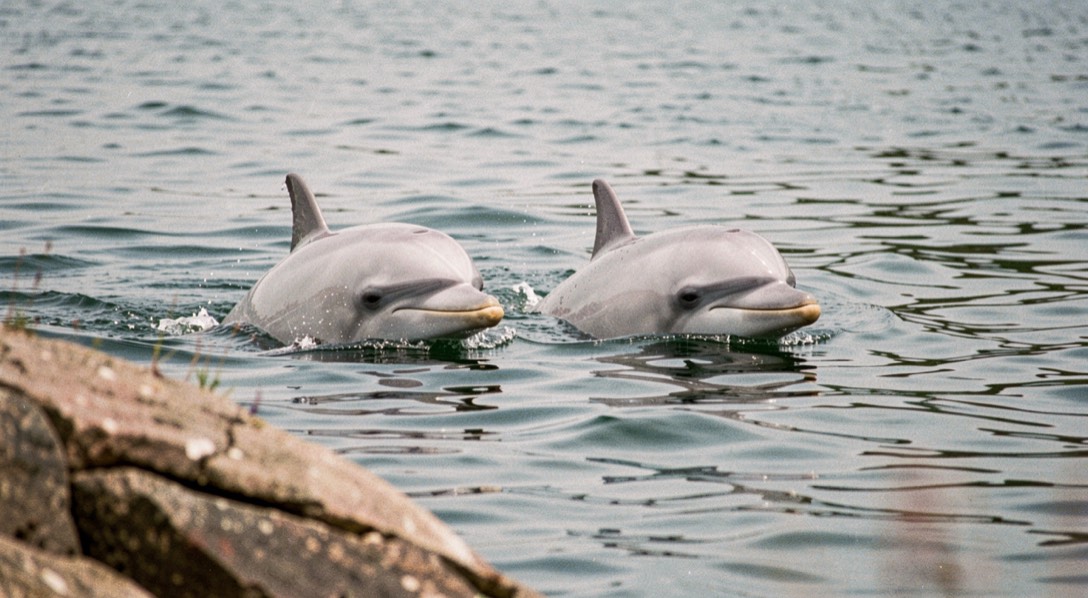
The bottlenose is the dolphin that most rewards a fixed watching position, because it is the dolphin most likely to be working the same piece of coast you are standing on. The Hebridean Whale and Dolphin Trust describes Hebridean bottlenose dolphins as most frequently seen in inshore waters, close to the coastline around headlands and bays. A headland is not a compromise for this species. It is the right seat.
How big is a west coast bottlenose?
Larger than most people expect. The Hebridean Whale and Dolphin Trust gives up to 3.9 metres and around 400 kilograms for a fully grown Scottish animal, and notes that this is somewhat larger than their counterparts worldwide. At distance that reads as bulk: a heavy grey animal that displaces water when it surfaces, not the quick flicker of a porpoise or the spray of a common dolphin.
Colouring is dark grey on the back, light grey on the sides and near white underneath. Older animals often carry marks and scars from other animals, including rake marks made by other dolphins’ teeth, and those scars are the reason individuals can be catalogued. The teeth behind the marks are conical, 18 to 26 pairs in each jaw, and the diet they serve is a wide variety of fish, squid, cuttlefish and crustaceans.
How they travel, and why that helps a watcher
The Trust describes social groups of three to ten animals, with larger groups not uncommon, and gives a normal travelling speed of about 2 miles per hour with brief bursts over 30. It also calls them famously inquisitive, active and playful, often seen bow riding and leaping clear of the water.
For a shore watcher the useful part is the slow travel. A group moving at walking pace along a coast can be held in the glasses for a long time, which is unusual here, and it means a single sighting can become twenty minutes of observation rather than four seconds.
All cetaceans in these waters are European Protected Species, and it is an offence under regulation 39(2) of the Conservation (Natural Habitats, &c.) Regulations 1994 to deliberately or recklessly disturb any dolphin, porpoise or whale. A headland keeps a watcher on the right side of that line.
How many of them are there?
Around 50 on the whole west coast, on the Trust’s count.
How few there are
Photo identification by the Hebridean Whale and Dolphin Trust has found a population of 30 to 40 animals inhabiting the Inner Hebrides between Kintyre and Skye, and a separate group of about 12 animals in and around the Sound of Barra.
The Trust puts the west coast total at around 50 animals, and the whole UK inshore population at fewer than 300 individuals.
A bottlenose sighting on the Minch is therefore not a common event dressed up as a rare one. When Whale and Dolphin Conservation reports that bottlenose sightings peak in summer, and that its Shorewatch data show less concentrated presence in the Moray Firth and more activity further south, it is describing the movements of a population you could put in a single field.
Where they are listed, here and elsewhere
The Hebridean Whale Trail lists bottlenose dolphins among the species to look for at the Butt of Lewis, at Tiumpan Head, at Clachtoll in Assynt, at Gallan Head and at Gairloch. The Butt of Lewis page adds a detail worth knowing: large groups of Risso’s dolphins have been recorded there mixing with bottlenose dolphins, and the two species occasionally breed, producing rare hybrid animals.
The Hebridean Whale and Dolphin Trust names the Moray Firth on the east coast of Scotland and Cardigan Bay in west Wales as the other notable UK populations. That context is useful on this coast: the animals a visitor may have watched from a pier on the Moray Firth are a different, larger and far better known group than the fifty or so that use the west.
Telling a bottlenose from a Risso at range
This is the identification that actually comes up on north east Lewis, because both species are there. The Trust’s descriptions give the test. A Risso’s dolphin has no prominent beak, a blunt bulbous melon, and a body that lightens and scars with age until an old animal can look nearly white. A bottlenose stays grey. If an animal at a kilometre reads as pale, it is far more likely to be a Risso.
What not to record
The Sea Watch Foundation asks for a confidence level with every identification: definite, probable or possible. A pale distant dolphin recorded as probable, with a note of the features seen, is a better record than a confident guess.
Feeding you can see, and threats you cannot
Two behaviours in the Trust’s profile are large enough to read at range. The first is cooperative feeding, in which several dolphins work together to herd fish to the surface. From a headland this looks like a group that stops travelling and starts circling, with the water going white in a small area and birds arriving.
The second the Trust calls fish whacking: bottlenose dolphins are known to use their powerful tails to strike fish in order to stun and catch them. A single hard tail slap in otherwise calm water, repeated, is not play.
The threats, in the Trust’s own terms, are accidental capture in fishing gear, degradation of the marine habitat, the bioaccumulation of chemical contaminants, and shipping activity, which may cause injury from collisions, with noise from seismic and military vessels interfering with navigation, foraging and communication. None of those is visible from a headland.
Sources
The facts on this page were read back against the pages below on 5 September 2026.
- Hebridean Whale and Dolphin Trust, Bottlenose dolphin species profile, consulted 5 September 2026.
- Hebridean Whale Trail site pages for the Butt of Lewis, Tiumpan Head, Clachtoll and Gairloch, consulted 5 September 2026.
- Whale and Dolphin Conservation, Shorewatch analysis, 1 February 2026.