Species
Humpback whales on the north-west coast
Still rare in UK waters, still recovering from whaling, and the one large whale here that announces itself: a four metre blow and a lifted tail.
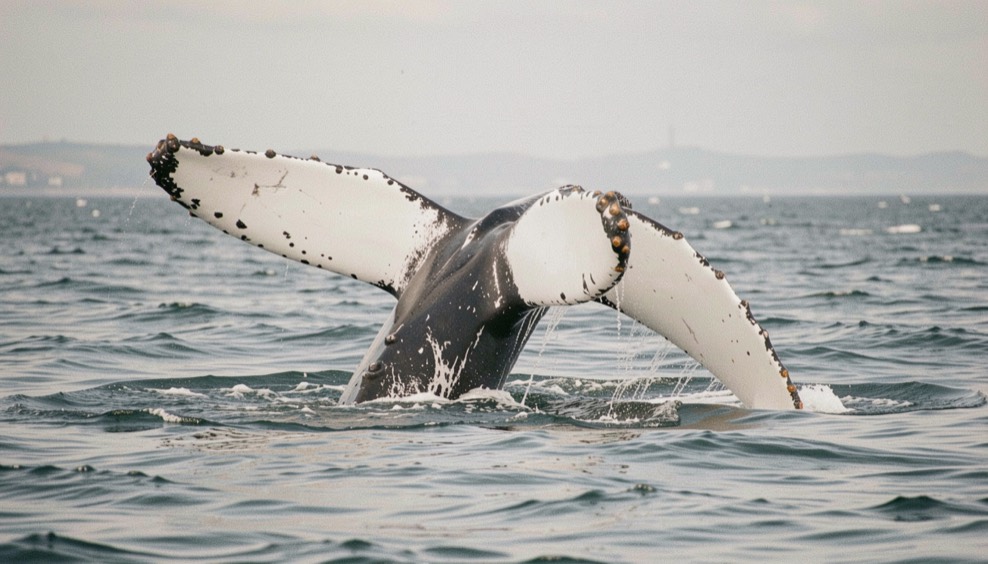
A humpback is the opposite of a minke as a shore sighting. Where the minke gives you almost nothing above the water, the humpback gives you everything: a tall bushy blow, a long arching back, and a broad tail lifted clear before the dive. The Hebridean Whale and Dolphin Trust describes the blow as bushy and as tall as four metres. On a still day that column is visible from a headland long before the animal is.
What settles the identification at range?
Two features. The pectoral fins are long, narrow and mostly white, and may be as much as five metres long, which is where the genus name Megaptera, great wing, comes from. The dorsal fin is small and hooked and sits far down the back on a hump, and the back ahead of it is long and arching. At a distance those long white fins do most of the work.
Around them sits a very large animal. Fully grown humpbacks reach up to 17 metres and 40,000 kilograms, females normally slightly larger than males. The head carries knobbly tubercles, which are enlarged hair follicles. The body is predominantly black with white patches underneath, and 14 to 22 white ventral pleats run from the lower jaw to mid belly.
The dive, and what the raised fluke is worth
The Trust records that humpbacks can dive for up to 40 minutes and raise their tail fluke when making a deep dive. The fluke can measure up to five metres across. For a watcher, the raised fluke is both the confirmation and the end of the sighting. Photograph it if you can.
Because the colouring and the serrated trailing edge of a humpback fluke are unique to each animal, that photograph is an identity, not a souvenir. Even a distant frame that shows the pattern of black and white on the underside can be matched. Sightings can be reported to the Hebridean Whale and Dolphin Trust through Whale Track, or to the Sea Watch Foundation with the key features noted. The Gaelic name recorded by the Trust is muc-mhara chrotach.
When do the sightings arrive?
From the late autumn into winter, and the animals are migrants rather than residents: the Trust’s distribution note places Hebridean encounters on animals travelling between breeding grounds off Africa and feeding grounds around Iceland and Norway.
The seasonal signal
Whale and Dolphin Conservation’s Shorewatch analysis, published 1 February 2026, reports that humpback whales show a pulse in sightings from the late autumn into winter when data are combined across larger regions rather than looked at site by site.
The Trust’s own factfile lists the species for January to December.
For a shore watcher, that changes the shape of the year. The months when almost no one is standing on a Lewis or Wester Ross headland are the months in which the standardised watches record the pulse, which makes the humpback a reason to keep watching after the tourist season ends: an argument for the winter entry in this journal, not against it.
Behaviour to expect, and not to expect
The Trust notes that humpbacks are normally seen as solitary individuals or in small groups of up to seven animals, with long term associations rare. They are well known for energetic breaching and lobtailing, although the reason is not fully understood, and they can be inquisitive, approaching boats to spy hop and slap their pectoral fins.
Song belongs to the breeding grounds, not to Scotland: males sing long complex songs during the breeding season in the tropics, where the animals do not feed and live on blubber reserves. A humpback here is a feeding animal, on krill, herring and cod in British waters, sometimes using the bubble netting technique described below.
Bubble netting, and what it looks like from a clifftop
Bubble netting, of the feeding methods named above, is the one that plays out in view of the shore. The Trust describes the technique plainly: humpbacks produce a ring of bubbles to drive fish together and push them up towards the surface, where they are taken in a single huge gulp, with the fish appearing disoriented and unwilling to swim through the bubbles.
Seen from land in flat conditions, the giveaway is the ring itself, a circle of disturbed pale water appearing on an otherwise unbroken surface a few seconds before anything else happens. A few seconds is enough to fix the spot and hold it, because the surface inside the ring is where the fish are taken. It is one of the few cases where the water tells you what is coming before the animal does.
Where the Trail lists them, and what threatens them
The Hebridean Whale Trail names humpback whales in the species lists for Tiumpan Head, Gallan Head and Cape Wrath. That is a shorter list than for minke or porpoise, and it reflects reality rather than modesty.
How rare is rare
The Trust states that in the UK humpback sightings are rare, while noting evidence that the North Atlantic population has recovered somewhat since the whaling moratorium was established in 1982. Both halves of that sentence are true at once, and both belong in a record.
Historically, commercial whaling, which severely depleted the global population. Today, collisions with vessels, entanglement in fishing gear, pollution and reduction in prey stocks. As with every cetacean in these waters, deliberate or reckless disturbance is an offence under regulation 39(2) of the Conservation (Natural Habitats, &c.) Regulations 1994.
Sources
The facts on this page were read back against the pages below on 5 September 2026.
- Hebridean Whale and Dolphin Trust, Humpback whale species profile, consulted 5 September 2026.
- Whale and Dolphin Conservation, Shorewatch analysis, 1 February 2026.
- Hebridean Whale Trail, Tiumpan Head, Gallan Head and Cape Wrath site pages, consulted 5 September 2026.