Species
White-beaked dolphin: a cold water dolphin
A powerful North Atlantic dolphin whose numbers here may be falling as common dolphin numbers rise. The saddle patch is what settles it.
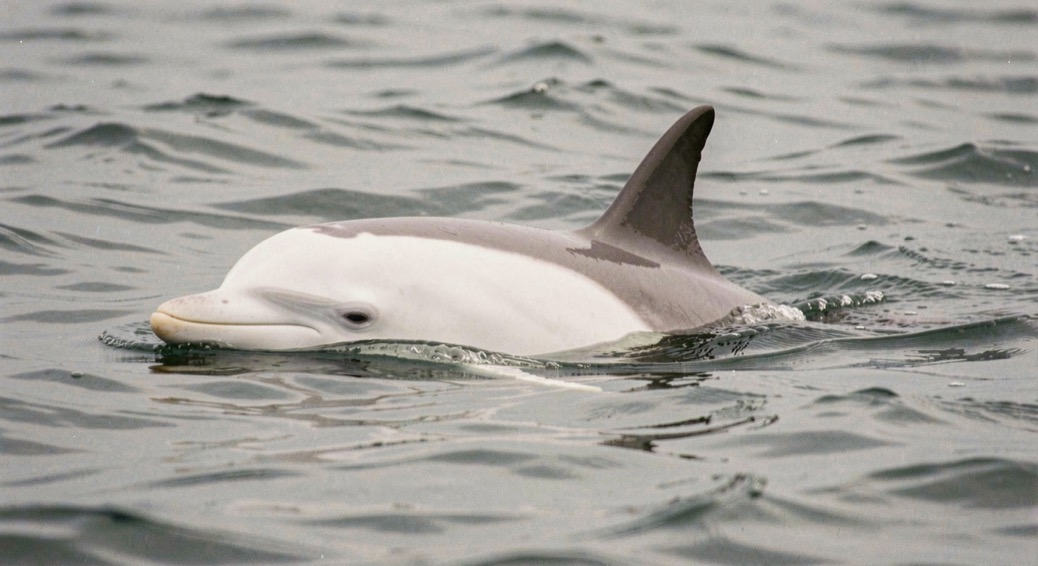
This is a dolphin of cold water, and the UK is the bottom edge of where it lives. The Hebridean Whale and Dolphin Trust states that the white beaked dolphin is found only in the temperate and subarctic waters of the North Atlantic, and that UK shores represent the southern limit of its distribution. Everything else about the species on this coast follows from that.
The field marks that work
Build first: sturdy and robust bodied, reaching 3.1 metres and up to 350 kilograms fully grown. That is a big dolphin, close to bottlenose size.
Then the pattern. The back, tail and pectoral fins are dark grey, with greyish white flashes along the flanks and a pale grey patch behind the dorsal fin, which the Trust names the saddle patch. The dorsal fin itself is dark grey, tall and falcate. The beak is short and often entirely white, which is where the name comes from and which is also the one feature you will almost never see from a clifftop.
The saddle patch is the mark to hunt for. It sits behind the fin, it is pale against a dark back, and it is large enough to register at range in decent light.
How it moves
Fast and powerfully. The Trust describes animals attracted to boats to bow ride, quite acrobatic, and frequently porpoising, meaning jumping clear of the water, when travelling at speed. Group sizes are usually five to 20 animals, occasionally several hundred.
From land, a fast group of large dolphins porpoising in a line across open water in the outer Minch is the picture. What separates it from a common dolphin pod is the absence of the creamy hourglass flank and, usually, a smaller number of animals.
Where to expect them
The Trust places white beaked dolphins in open waters further from the coast in the Hebrides, favouring the waters around the Outer Hebrides. The Hebridean Whale Trail Spotter’s Guide gives the habitat as open water, Outer Hebrides.
Of the sites on the Trail, Cape Wrath is the one whose species list names white beaked dolphins explicitly.
Is it becoming rarer here?
The Trust reports that some research suggests white beaked dolphin numbers have declined in recent years while common dolphin abundance has increased, and raises the possibility that the two species are competing for habitat or food. It also names rising sea temperatures from climate change as a factor that may affect the future distribution of white beaked dolphins in UK waters, precisely because this is the southern edge of the range.
For a shore watcher that is not an abstraction. It means the balance of what passes a Lewis headland in August is not fixed, and that a careful record kept now has value later.
What it eats, and who it travels with
The diet is broad: small schooling fish such as sandeels and herring, larger bottom dwelling fish including cod, whiting and haddock, plus molluscs, squid, octopus and some crustaceans. The Trust records that they work together when feeding, using whistles, tail slaps and leaps to coordinate a hunt.
One detail matters for a watcher scanning around a feeding minke: the Trust notes that white beaked dolphins may also associate with feeding minke whales and humpback whales. A minke in a feeding flock is worth watching for the company it keeps.
The honest call
White beaked and Atlantic white sided dolphins are the hardest genuine pair on this coast. If the saddle patch behind the fin is not seen, and the yellow blaze towards the tail is not seen, the record is dolphin sp. The Sea Watch Foundation form is built to accept exactly that.
Why keep a shore record of this species?
A white beaked dolphin record does something most shore sightings on this coast do not: it sits on the line of a possible range shift, rather than confirming what is already known. If the Trust is right that numbers may be declining here while common dolphin abundance rises, then the dates and places of white beaked sightings over the next decade are the evidence that will show it.
The Hebridean Whale and Dolphin Trust takes public sightings through its Whale Track scheme, and the Sea Watch Foundation takes them through its Sea Watcher app or through the land based recording form. Either route puts a headland observation into a dataset. Neither requires anything more than a date, a place, conditions and an honest confidence level.
The name, the law and the pressures on it
The Gaelic name recorded by the Trust for this dolphin is leumadair ban-ghobach. The species has no protected area of its own on this coast, but it is a European Protected Species like every cetacean in these waters, and the disturbance offence in regulation 39(2) of the Conservation (Natural Habitats, &c.) Regulations 1994 applies to it exactly as it applies to a porpoise in Loch Broom.
The Trust names incidental capture and drowning in gillnet, driftnet and trawl fisheries as a major threat to the species in these waters, alongside marine pollution, habitat degradation and disturbance caused by boating activity. Climate driven range shift, the pressure already named above, sits on top of all of it.
Sources
The facts on this page were read back against the pages below on 5 September 2026.
- Hebridean Whale and Dolphin Trust, White beaked dolphin species profile, consulted 5 September 2026.
- Hebridean Whale Trail, Spotter’s Guide and Cape Wrath site page, consulted 5 September 2026.